
TL;DR

Get decor and gifts delivered free with Prime
- Fast, free delivery on millions of items
- Prime Video, Amazon Music and more included
- Member-only deals all year
Livingetc outlines four Japanese-inspired tablescaping practices for autumn hosting: combine individual place settings with shared dishes, choose some tableware for the person using it, match vessels to the food, and signal the season through plates and bowls. The advice is design guidance, not a report of a new study or formal change in Japanese dining customs.
Livingetc has published four Japanese-inspired tablescaping lessons for autumn hosting, recommending a blend of individual place settings and shared dishes, personal tableware, vessels chosen to complement food, and seasonal changes to plates and bowls. The report presents these as adaptable design ideas for Western homes, rather than rules that every Japanese household follows.
The first suggestion is to combine a place setting for each guest with shared dishes in the middle. The report describes an individual place as including a flat tray, rice bowl, soup bowl and small plate for taking food from communal dishes. Diners can serve themselves as the meal continues, rather than choosing only between fully plated courses and an entirely family-style spread.
Its second lesson is to consider the person using each item instead of buying a uniformly matching set. The report says that, in the Japanese practice it describes, family members may have their own rice bowls and chopsticks, selected for factors such as hand size and preferred grip. For an autumn table, that could mean mixing pieces with personal significance or practical differences, while keeping them useful for the meal.
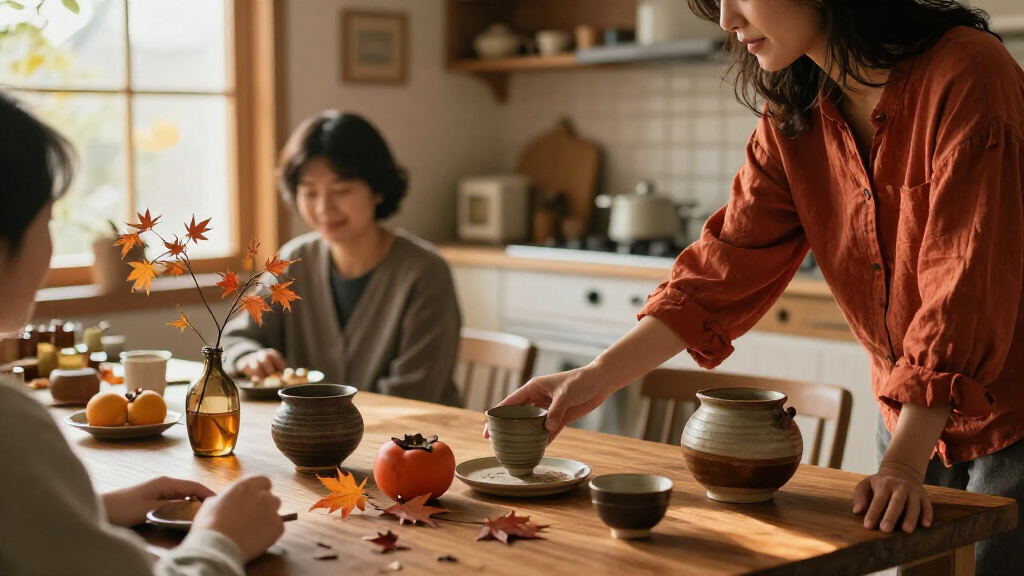
The third recommendation treats the vessel as part of the dish: shape, weight, warmth and the empty space around the food all contribute to how a meal is presented and experienced. The article points to small plates called mame-zara as one way to add variety; these saucer-sized pieces can be collected individually and mixed or matched. Its final lesson is to change tableware, not the whole table. For autumn, the report suggests warm clay and persimmon or rust tones, with a small seasonal detail such as a chrysanthemum-shaped chopstick rest.
Small Choices Shape Autumn Meals
The recommendations offer hosts a way to make a meal feel welcoming and considered without replacing the dining room or adding elaborate decoration. Individual items can help guests feel thought of, while shared serving dishes keep food accessible to the table. Seasonal bowls or plates provide a visual cue that can be changed from one part of the year to another.
The approach also gives readers practical options at different budgets: a host could begin with one small plate or a few personal bowls rather than buying a complete new set. The article’s suggestions are aesthetic and cultural guidance, not evidence that a particular setup improves the experience for every guest. Their value will depend on the food, the occasion and the people at the table.
Popular right now

De'Longhi Linea Classic Espresso Machine with Adjustable Milk Frother

Vitamix Propel Series 750 Professional-Grade Blender, 4 Programs, Black

Sony WH-1000XM6 Wireless Noise-Canceling Over-Ear Headphones, Blue, Bundle
As an affiliate, we earn on qualifying purchases.
Four Practices Behind the Advice
The source is a Livingetc design report produced in collaboration with Nakagawa, a craft maker and retailer founded in Nara in 1716, according to the article. It frames the recommendations as habits observed in Japanese autumn tablescapes that can be adapted to Western dining. It does not provide survey data or claim that the practices are universal.
The report also connects seasonal tableware to a broader practice of making small seasonal arrangements, or shitsurai. Its example is to move from summer glass and white porcelain toward autumnal clay and warmer colors, and to welcome the coming season slightly early. It attributes the phrase comparing a vessel to clothing for food to potter Kitaōji Rosanjin, who opened a Tokyo restaurant in 1925. That reference supports the article’s emphasis on choosing tableware in relation to the meal, rather than treating dishes as decoration alone.
““Change the plates, not the table.””
— Livingetc report
How Far the Customs Apply
The source offers design advice rather than independently verified research. It does not establish how widely each practice is used across Japan, how customs differ by household or region, or whether the recommendations are equally suited to every kind of autumn meal. The article also gives no publication date in the supplied material, so its timing cannot be stated more precisely.
Readers should treat the examples as inspiration, not a checklist of requirements for an authentic Japanese table. The report does not say that hosts need specialist ceramics, a full matching collection or any particular menu to use the ideas.
Try One Seasonal Change
The report does not announce a product launch, event or follow-up milestone. Its practical next step for readers is to apply one or more of the four ideas to an upcoming meal: set out a shared serving dish alongside individual bowls, assign a favorite bowl to a guest, add a small plate, or bring in a warm-toned vessel. Hosts can then adapt the choices to their menu and the people they are welcoming.
For readers seeking more background, the Livingetc article points to Nakagawa as a source of tableware and closes by suggesting that Japanese kitchen storage practices may also help with seasonal table setting. No further reporting or update is specified in the supplied source.
Key Questions
What are the four Japanese-inspired tablescaping lessons?
Combine individual settings with shared dishes, choose tableware with the person using it in mind, consider how a vessel suits the food, and change plates or bowls to signal the season.
Does the advice require buying a new dinnerware set?
No. The report suggests that hosts can mix pieces and add small items, such as a mame-zara, rather than replacing a full set. It does not set a budget or say new purchases are necessary.
What tableware does the report suggest for autumn?
It recommends warm clay and persimmon or rust tones, with a restrained seasonal accent such as a chrysanthemum-shaped chopstick rest. These are examples, not required colors or objects.
Are these practices followed in every Japanese home?
The source does not claim that. It describes practices associated with Japanese tablescapes and presents them as ideas readers can adapt; it does not document how common they are across households.
Source: rss