
TL;DR

Get decor and gifts delivered free with Prime
- Fast, free delivery on millions of items
- Prime Video, Amazon Music and more included
- Member-only deals all year
PINCH co-founder Russell Pinch says the Anders pendant began as a light made for a studio photoshoot in 2009 and took five years to perfect. Its layered banana-fiber shade is still handmade, and the design has grown from a slow-selling piece into one of the studio’s most requested lights, with a wall-light version added to the range.
PINCH co-founder Russell Pinch has described how the studio’s Anders pendant grew from a lamp made for a 2009 photoshoot into a handmade design that took five years to perfect. In an interview with Livingetc, he said the shade’s layered banana fiber was chosen to create the drape and changing light of fabric—an approach that now distinguishes one of PINCH’s most requested lights.
Pinch said the initial brief was practical: PINCH needed a light above a table for a shoot featuring some of the studio’s early furniture. Looking through fashion magazines, he noticed a Lanvin dress caught in motion, with its outer skirt lifting to reveal the layers beneath. That image became the starting point for the lamp. His first attempt, he recalled, was a rough model made from fabric, intended to convey movement rather than resolve how the shade could be built.
Turning the idea into a working object proved difficult. Pinch was freelancing for Jasper Conran when he took the model to the company’s creative director for advice. She told him it was a millinery problem, not a tailoring one. Manufacturers had suggested plastic, but Pinch said that would lose the soft, textile-like quality he wanted. The breakthrough came with banana fiber, whose translucency diffuses the light through the shade’s overlapping layers.
Production remains labor-intensive, according to PINCH. The layers are cut, stiffened, sewn and pinned, then shaped by hand. Pinch said makers check the angle of each drape, even though the finished arrangement is meant to appear loose. The original pendant now sits alongside other versions, including a wall light. Livingetc reports that Anders fixtures have appeared in private homes and commercial settings, including a Texas yoga studio.
Why the Handmade Shade Endures
The Anders story offers a concrete example of how an apparently simple decorative object can depend on difficult, repeatable craft. Its folds may look improvised, but PINCH says their angles are carefully controlled; the material is selected not only for appearance but for the way it shapes the light. That distinction matters to buyers and specifiers comparing sculptural lighting with mass-produced shades: the form, material and manufacturing method are closely linked.
The design’s commercial history also complicates the idea that a successful product finds an audience immediately. Pinch told Livingetc that the lamp sold only modestly for almost a decade, but PINCH kept it in the collection partly because the studio continued to use it in photography. Its later demand suggests that a design’s visibility and use can build gradually, rather than following a quick launch-to-hit trajectory. The newer wall-light format also shows the studio extending the design language beyond a pendant without abandoning its defining layered shade.
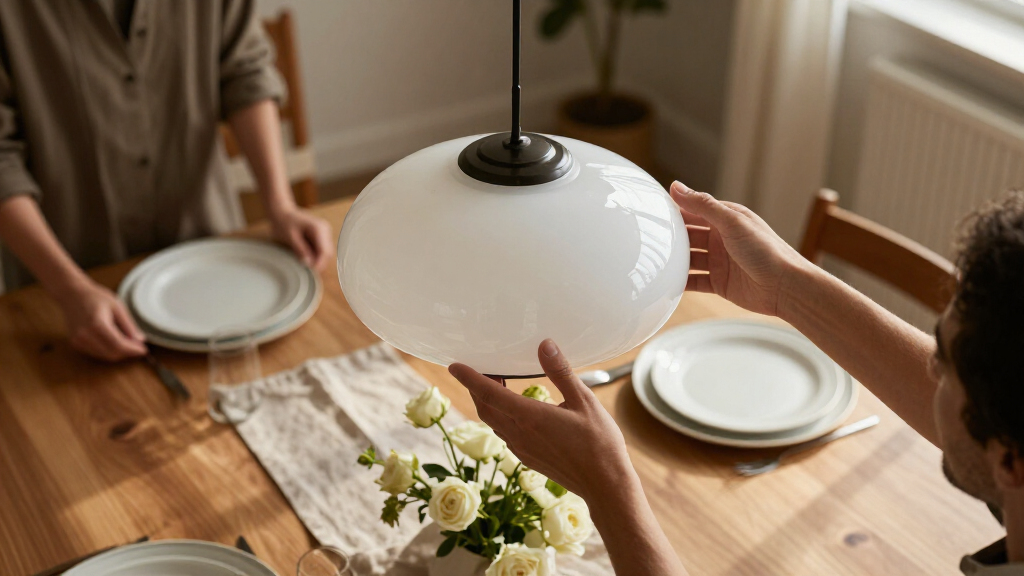
handmade banana fiber pendant light
As an affiliate, we earn on qualifying purchases.
As an affiliate, we earn on qualifying purchases.
From Photoshoot Prop to Collection
PINCH was founded in 2004. When the Anders idea emerged in 2009, Pinch said the studio had only a handful of designs, including the Avery chair, Harper table and Moreau sofa. The pendant was conceived to complete a photograph of those pieces, not as a product intended for sale. That origin helps explain why its development began with an image of movement and atmosphere rather than a conventional lighting brief.
Pinch told Livingetc that it took five years to get the lamp right. Even after it entered the collection, it did not become a strong seller at once. He said PINCH sold enough to justify retaining it, but only just, and that the team might have discontinued it without its affection for the design. The interview describes a later rise in interest, with the Anders becoming one of the studio’s most requested pieces. It does not provide sales figures or dates for that change.
Designer Lonika Chande, whose project featuring the light appeared in Livingetc, praised the effect of the material when illuminated. Her comment reflects the lamp’s role in interiors as both a sculptural object and a source of warm, diffused light, rather than serving only as a functional fixture.
“I wanted it to have the drape of a dress. Anything less would have looked a bit soulless. It needed that soul.”
— Russell Pinch, PINCH co-founder, speaking to Livingetc
As an affiliate, we earn on qualifying purchases.
Sales and Materials Remain Unspecified
Livingetc’s account does not give sales totals, the date when demand began to rise, or production volumes for the pendant. It also does not specify the exact composition or sourcing of the banana-fiber material, the price of each size, or whether the wall-light version uses the same construction in every detail. The report attributes the design and manufacturing history to Pinch and PINCH but does not include independent production records or a separate company statement. Those details should not be inferred from the design’s reported popularity.
artisanal fabric shade pendant lamp
As an affiliate, we earn on qualifying purchases.
As an affiliate, we earn on qualifying purchases.
The Anders Range Continues
PINCH’s Anders range currently includes pendant forms and a wall-light version, according to the Livingetc report. No future launches, production changes or new milestones were announced in the source material. The next clear development for readers to watch is whether PINCH adds further formats or shares more detail about how the handmade lights are produced; neither was confirmed in the interview.
As an affiliate, we earn on qualifying purchases.
Key Questions
When did Russell Pinch first design the Anders light?
Pinch said he designed the initial version in 2009 for a PINCH furniture photoshoot. It was not originally intended to be a product for sale.
Why did the Anders take five years to perfect?
The concept depended on giving the shade a soft, fabric-like drape while making it suitable for a light. Pinch said the studio tested construction options before settling on layered banana fiber and refining the handmade process.
What is the Anders shade made from?
The Livingetc report describes it as made from banana fiber, selected for its delicate translucency and ability to diffuse light. The report does not provide further details about the fiber’s sourcing or precise composition.
Is the Anders still handmade?
Yes. According to the report, each light is handmade. Its layers are cut, stiffened, sewn and pinned before being sculpted, and PINCH checks the angle of each drape.
Does the Anders come in a version other than a pendant?
Livingetc reports that PINCH has added a wall-light version to the Anders range. The source does not give details about additional future versions.
Source: rss
Fall Picks
fall essentials
As an affiliate, we earn on qualifying purchases.