TL;DR

Get decor and gifts delivered free with Prime
- Fast, free delivery on millions of items
- Prime Video, Amazon Music and more included
- Member-only deals all year
Architect and designer Ben Uyeda showed a DIY method for carving smooth river rocks into bowls with an angle grinder, a diamond tile blade, and a hammer and chisel. The project can produce decorative stoneware, but the source report cautions that porous river rocks should not be used for food without appropriate testing and a food-safe finish.
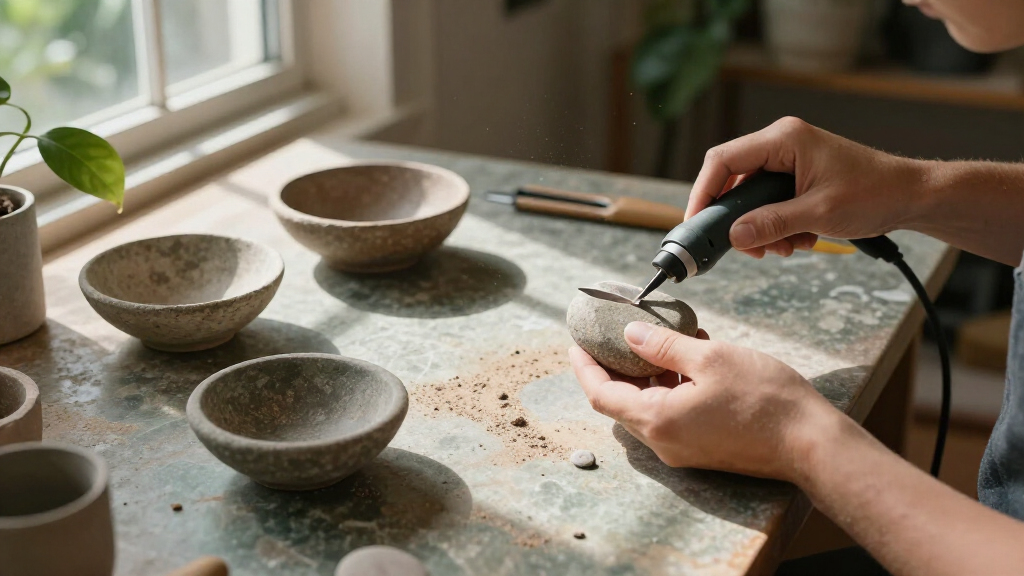
Architect and designer Ben Uyeda demonstrated carving river rocks into bowls in a TikTok video, using an angle grinder fitted with a diamond tile blade. The method offers a way to make decorative stone bowls from found materials, but food use is not automatically safe: Uyeda says rock samples should be tested and the finished bowl treated with a food-safe finish.
In the video, Uyeda says the bowls are for a restaurant at a hotel he is building. He steadies each smooth rock in a sandbox, which holds it in place while he works. The Hunker report describes the process as starting with flattening the stone’s base so the finished bowl can sit more securely.
For a small bowl, Uyeda makes a series of cuts in a radial pattern with the grinder, then removes the cut stone with a hammer and chisel to create a rough hollow. He grinds that depression smooth afterward. For a larger, oblong bowl, the report says, he cuts a grid into the stone before breaking out the material. Uyeda also mentions a diamond ball grinder with an extension shaft as another carving option.
The approach requires more than finding a rock and shaping it. Hunker reports that porous stone can be difficult to sanitize, and river rocks may carry contaminants. Uyeda says samples should go for laboratory testing and that food-contact surfaces need a food-safe finish. The report does not provide the results of testing on his own rocks or specify a particular finish used in the video.
Food Safety Shapes the Project
The main practical distinction is between making a stone bowl as decor and using it to serve food. An attractive carved surface does not establish that a rock is suitable for food contact. Porosity and contamination risks make the source material and its treatment relevant, especially where the bowl could touch food directly.
Testing and sealing can also change the cost calculation. Hunker cites a price of $55.63 for a pint of MORE Stone Sealer at Walmart as an example of the expense of a food-safe product; the report does not say that this is the finish Uyeda used. For a one-off project, the bowl may make more sense as a key dish or decorative object unless the material and finish can be verified for food use.
The video also shows a way to adapt basic stoneworking techniques for a household-scale object. The result may look like a high-end piece, but the finished bowl’s value depends on workmanship, stone, and intended use—not appearance alone.
diamond tile blade for angle grinder
As an affiliate, we earn on qualifying purchases.
As an affiliate, we earn on qualifying purchases.
From Restaurant Project to DIY
Uyeda’s TikTok is titled “I [am] carving rocks into bowls using my @RYOBI Tools USA angle grinder.” The Hunker report says he uses a diamond tile-cutting blade and a sandbox to hold the rock. The project is presented as part of work on a hotel restaurant, rather than as a tested guide for making food-safe tableware at home.
The report notes that stoneworkers use related methods to make a range of objects, including sinks, plates, mugs, vases, candle holders, and soap dishes. It also compares stone bowls across a broad retail range, from $8.99 to $2,800, depending on size and craftsmanship. Those prices are the report’s examples, not a claim that a DIY bowl has a particular market value.
Hunker cautions that mineral composition can matter: some minerals and sulfide-bearing stones may present concerns, and pollution can also come from human activity. Rather than relying only on visual inspection or general mineral knowledge, the report points to testing as a way to assess a specific rock.
“I [am] carving rocks into bowls using my @RYOBI Tools USA angle grinder and a diamond tile blade.”
— Ben Uyeda, in the TikTok video cited by Hunker
As an affiliate, we earn on qualifying purchases.
Testing and Finish Details
The source material does not identify the specific river rocks Uyeda used, report laboratory findings, or name a food-safe finish applied to the bowls. It also does not provide a detailed safety protocol for operating the grinder or confirm whether the finished pieces have been approved for serving food. Food safety remains unverified for the rocks shown in the video.
The cited retail prices and sealer cost are examples from Hunker’s report; they may vary by seller and product. The report does not include a complete cost estimate for tools, testing, protective equipment, or finishing materials.
As an affiliate, we earn on qualifying purchases.
Before Using a Bowl for Food
Anyone considering the project should first decide whether the bowl will be decorative or used with food. For food contact, the rock needs appropriate testing and a finish specifically suitable for that use; if those steps cannot be confirmed, the safer choice is to keep the bowl for non-food storage or display.
Carving also involves a high-speed angle grinder and stone fragments. Follow the tool manufacturer’s instructions and use suitable protective equipment, including eye and respiratory protection; secure the rock before cutting and keep others clear of debris. The source report describes Uyeda’s sandbox setup but does not offer a full workshop safety guide.
As an affiliate, we earn on qualifying purchases.
Key Questions
What tools does the river-rock bowl method use?
Uyeda uses an angle grinder with a diamond tile blade, then a hammer and chisel to break out the cut stone. He uses a sandbox to hold the rock while working.
Can a carved river rock bowl be used for food?
Not based on appearance alone. Hunker says the rock should be tested and the bowl treated with a food-safe finish. The report does not provide test results for Uyeda’s stones.
Why does the rock need testing?
River rocks can be porous and may be difficult to sanitize; their composition and possible contamination can vary. Testing can help assess a specific stone rather than relying on appearance or assumptions about its source.
What else can a DIY stone bowl hold?
If it has not been verified for food use, it can serve as a decorative or storage bowl for items such as keys. Related stone-carving techniques are also used for objects including vases and soap dishes.
Source: rss
Evergreen bestsellers Picks
bestsellers
As an affiliate, we earn on qualifying purchases.