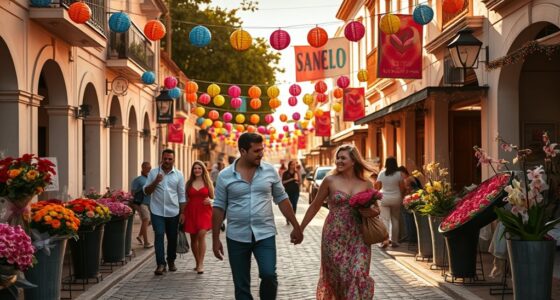
Valentine’s Day started in Roman times as a fertility celebration and evolved through Christian influence to honor Saint Valentine’s acts of kindness. Over the centuries, it grew into a cultural event emphasizing romantic love, with customs like gift exchanges and romantic gestures. Today, it’s celebrated worldwide, shaped by local traditions and global commercialization. Its core message of love remains universal, connecting people across different cultures. Keep exploring to discover how this holiday continues to adapt and inspire worldwide.

Get decor and gifts delivered free — and shop member deals
- Fast, free delivery on millions of items
- Access to Prime Big Deal Days deals on October 6–7
- Prime Video, Amazon Music and more included
Key Takeaways
- The holiday evolved from Roman and Christian traditions celebrating fertility and Saint Valentine’s acts of compassion.
- Cultural adaptations, like gift-giving and romantic gestures, spread globally through media and commercial promotion.
- International customs, such as White Day in Asia and family-centered celebrations in Latin America, diversified its meaning.
- The commercialization of love and media marketing helped popularize Valentine’s Day worldwide.
- Its core message of love and affection resonated universally, encouraging diverse expressions across cultures.

Have you ever wondered how Valentine’s Day, originally a Western tradition, has become a worldwide celebration? It’s fascinating to trace its journey from ancient roots to global recognition. The historical origins of Valentine’s Day date back to Roman times, where a festival called Lupercalia celebrated fertility and love. Later, it evolved through the influence of Christian martyr Saint Valentine, who was associated with acts of compassion and romantic love. In medieval Europe, the day became linked to courtly love, with poets and writers romanticizing the idea of expressing affection on February 14th. Over centuries, this evolving tradition gradually embedded itself into Western culture, shaping customs like exchanging cards, flowers, and chocolates. The spread of Valentine’s Day internationally was also facilitated by digital concepts, which helped connect cultures and promote shared traditions across borders.
But as the celebration spread beyond Europe, it took on different meanings and customs, reflecting each culture’s unique values and traditions. In some Asian countries, for example, Valentine’s Day is just one part of a broader love celebration. Japan and South Korea, in particular, have developed distinctive practices, where women give chocolates to men, and a month later, men reciprocate on White Day. Meanwhile, in Latin America, the day is often intertwined with family and friendship, with celebrations emphasizing community and shared affection rather than solely romantic love. These cultural variations demonstrate how Valentine’s Day adapts to local sentiments, making it more inclusive and meaningful.
The global spread of Valentine’s Day was accelerated by commercial interests and media, which helped popularize the idea of expressing love publicly. Companies promoted the holiday as a day for gift-giving, encouraging everyone to participate regardless of cultural background. Today, you can see Valentine’s Day celebrated in diverse ways—from romantic dinners in Western countries to colorful festivals in Asia and heartfelt gestures in Africa. The core idea remains the same: celebrating love, whether romantic, platonic, or familial. Its universal appeal lies in this flexible, inclusive message that resonates across borders.
As an affiliate, we earn on qualifying purchases.
Frequently Asked Questions
When Did Valentine’s Day Originate Historically?
You should know that Valentine’s Day originated in the medieval period, around the 14th and 15th centuries, rooted in medieval romance traditions. It’s believed to celebrate Saint Valentine, a figure associated with love and romance. People started exchanging love notes and gifts to honor him. Over time, this day evolved into a broader celebration of love, spreading across cultures and becoming the global event we recognize today.
How Do Different Cultures Celebrate Valentine’s Day?
Imagine love as a vibrant tapestry—each culture adds its own unique thread. In Japan, you give chocolates, symbolizing gratitude and affection, while in South Korea, both men and women exchange gifts, reflecting mutual respect. In Italy, romantic dinners and serenades are traditional customs, embodying passion. Cultural variations highlight how different societies celebrate love through symbols like flowers, gifts, and acts of kindness, making Valentine’s Day a global mosaic of heartfelt expressions.
What Are the Economic Impacts of Valentine’s Day Globally?
You’ll notice that Valentine’s Day markedly boosts global economic growth through increased consumer spending. People buy flowers, chocolates, jewelry, and dining experiences, which stimulates local businesses and creates jobs. This holiday also encourages retail sales and marketing campaigns, leading to higher profits for companies worldwide. As a result, Valentine’s Day acts as a powerful economic driver, fostering a cycle of spending that benefits various sectors across different countries.
Are There Any Alternative Symbols for Love Besides Hearts?
Just like the ancient Greeks used olive branches and laurel wreaths as romantic symbolism, you can explore other love representations beyond hearts. Symbols like doves, roses, and infinity signs also stand for love’s enduring nature. These alternative symbols carry deep meanings, connecting you to diverse cultural expressions of affection. Embracing different love representations enriches your understanding of romance, making your gestures more unique and meaningful beyond traditional heart imagery.
How Has Valentine’s Day Evolved With Digital Communication?
On Valentine’s Day, digital communication has transformed how you express love. You now engage in digital romance, sending heartfelt messages via texts or social media. Virtual gift giving has become popular, with e-cards, digital flowers, and online experiences replacing traditional presents. This evolution allows you to celebrate love globally, regardless of distance, creating a more immediate and personalized connection. You can share your affection instantly, making the day more accessible and meaningful.
As an affiliate, we earn on qualifying purchases.
Conclusion
So, now you see how Valentine’s Day spread across the globe, turning into a universal celebration of love. It’s a day that brings people together, regardless of where they are, reminding you that love truly knows no borders. As the saying goes, “love is in the air,” and this holiday proves it’s a feeling that can’t be contained. Whether you’re celebrating with a partner or friends, keep spreading that love—because it’s what makes the world go round.
As an affiliate, we earn on qualifying purchases.
As an affiliate, we earn on qualifying purchases.
Fall Picks
fall essentials
As an affiliate, we earn on qualifying purchases.