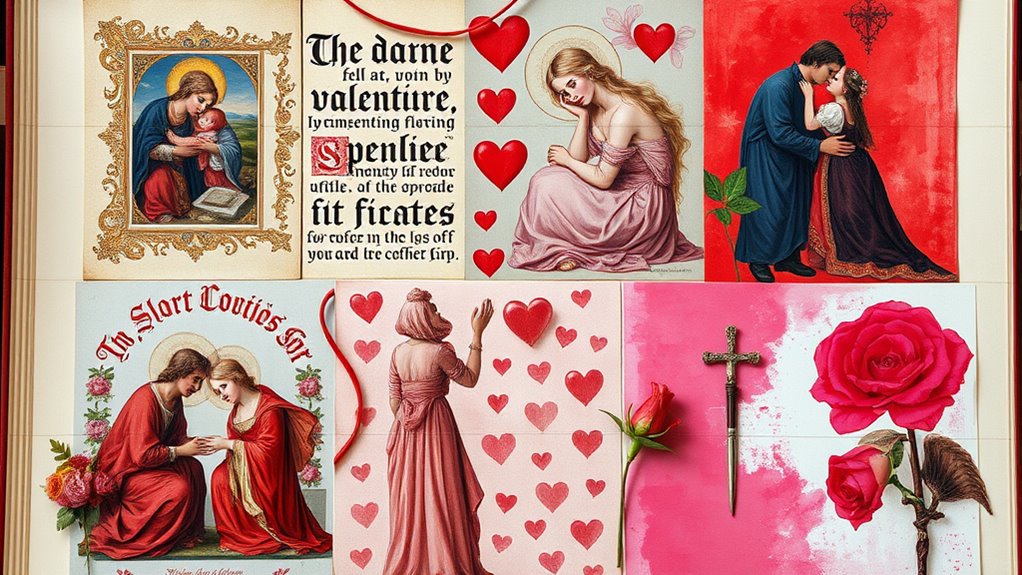

Throughout history, artistic depictions of St. Valentine have shifted from simple, symbolic medieval images emphasizing martyrdom and spiritual love, to detailed Renaissance scenes highlighting compassion and romance. Baroque artworks intensify emotion with dramatic light and color, while modern pieces blend tradition with contemporary themes, sometimes removing religious symbols altogether. These evolving portrayals reflect society’s changing views on love, faith, and sacrifice. Explore further, and you’ll discover how art continues to shape our understanding of this beloved saint.
Key Takeaways
- Early medieval art features symbolic, simplistic depictions emphasizing martyrdom and spiritual devotion over detailed personal features.
- Renaissance artists like Botticelli added humanized scenes with subtle love symbols, blending spirituality and romance.
- Baroque art uses dramatic lighting, vivid colors, and symbols like chains and doves to evoke emotional intensity and spiritual themes.
- Modern interpretations incorporate contemporary styles, abstract forms, and universal themes, often removing religious iconography.
- Artistic representations reflect evolving societal attitudes toward love, faith, and sacrifice, transforming religious stories into visual celebrations of human connection.
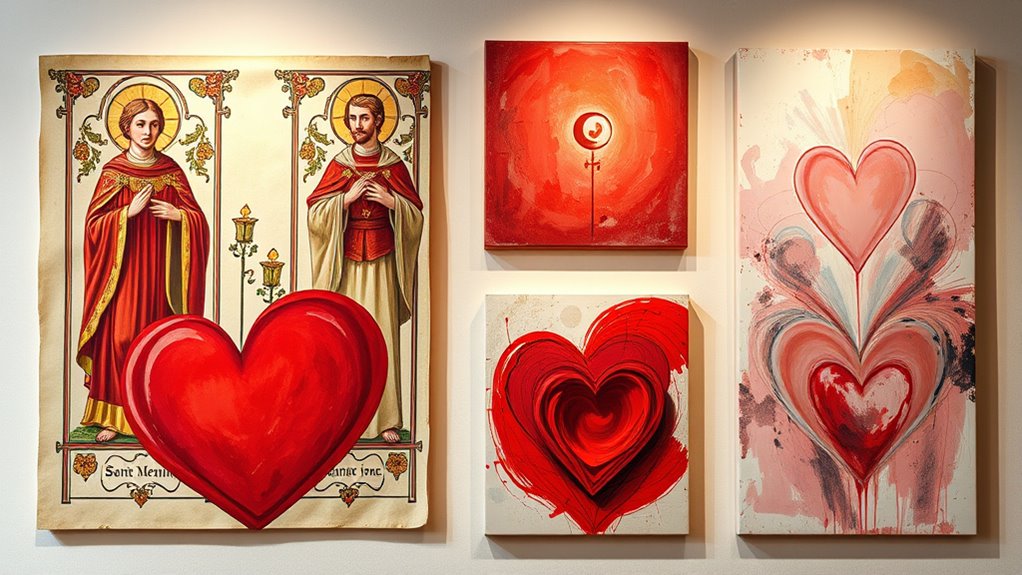
Throughout history, artists have depicted St. Valentine in a variety of ways that reflect changing cultural values and artistic styles. The symbolism in Valentine art has played a pivotal role in conveying deeper meanings, from love and sacrifice to spiritual devotion. Over time, the evolution of saint portrayals reveals how artists have adapted their depictions to resonate with different audiences and periods. In early medieval times, representations of St. Valentine were often sparse and symbolic, emphasizing his role as a martyr rather than detailed personal features. Artists used simple iconography—such as a heart, a scroll, or a martyr’s palm—to evoke his connection to love and sacrifice. These symbols served as visual shorthand, communicating the saint’s significance even to those unfamiliar with his story. As art progressed into the Renaissance, the portrayal of St. Valentine became more detailed and humanized. Artists like Botticelli and Titian focused on capturing the saint’s compassion and serenity, often depicting him in scenes of martyrdom or blessing. The symbolism in these works expanded to include subtle references to love—such as roses or Cupid figures—highlighting the association of Valentine’s Day with romantic affection. Moving into the Baroque era, the portrayals grew more dramatic and emotionally charged, emphasizing the saint’s spiritual strength and sacrifice. Artists employed dynamic compositions, rich colors, and intense light contrasts to evoke a sense of divine inspiration and martyrdom. These images often included symbolic elements like chains or a dove, representing peace and spiritual liberation. In modern art, the depiction of St. Valentine continues to evolve, blending traditional symbols with contemporary interpretations. Some artists focus on the universality of love, stripping away religious iconography to emphasize human connection. Others incorporate abstract forms or pop culture references, reflecting the evolving ways society perceives and celebrates Valentine’s Day. Despite these shifts, the core symbolism in Valentine art remains rooted in themes of love, sacrifice, and devotion. The evolution of saint portrayals demonstrates how artists adapt their techniques and symbols to communicate timeless messages in ways that resonate with each generation. Whether through simple iconography or complex allegories, the artistic representations of St. Valentine serve as visual narratives that connect viewers to a shared history of love and sacrifice. As you explore different artworks, you’ll notice how the symbolism in Valentine art has steadily deepened, mirroring society’s ongoing fascination with love’s spiritual and emotional dimensions. A notable aspect of art history is how the depiction of saints like Valentine can reveal societal attitudes toward love, faith, and sacrifice over centuries. This progression highlights the enduring power of art to transform religious stories into visual celebrations of human connection.

Catholic print picture – St. Valentine N – 8" x 10" ready to be framed
catholic print picture
As an affiliate, we earn on qualifying purchases.
As an affiliate, we earn on qualifying purchases.
Frequently Asked Questions
What Are the Origins of St. Valentine’s Legend?
You learn that St. Valentine’s legend has romantic symbolism rooted in early Christian martyrs. The historical origins trace back to a priest named Valentine who defied Roman laws by secretly marrying couples, symbolizing love and commitment. Over time, his story became associated with romantic symbolism, especially around February 14th. This blend of history and myth transformed him into a symbol of love, inspiring countless artistic representations through the ages.
How Has St. Valentine Been Depicted in Different Cultures?
You’ll find that St. Valentine’s depiction varies wildly across cultures, each adding its own twist with artistic symbolism. Some portray him as a romantic saint in Western art, while others emphasize martyrdom, reflecting cultural adaptations. In Asian cultures, he’s sometimes linked to love festivals, showcasing local traditions. These diverse images reveal how societies reinterpret his story, blending satire and reverence, transforming his legend into a symbol that resonates uniquely across the world.
Are There Any Controversial or Disputed Images of St. Valentine?
You might find some controversial or disputed images of St. Valentine because of mythical portrayals and historical disputes. Some depictions blend legend with fact, leading to debates over authenticity. For instance, certain artworks emphasize romantic symbolism that may not reflect historical truth, sparking disagreements among historians and artists. These conflicts make it clear that not all images are universally accepted, fueling ongoing discussions about St. Valentine’s true identity and significance.
How Did Medieval Paintings Influence Modern Valentine’s Day Symbols?
Medieval iconography and art symbolism heavily influence modern Valentine’s Day symbols. You’ll notice that the heart, arrows, and doves stem from medieval paintings depicting St. Valentine’s romantic legends. These images helped embed themes of love and devotion into contemporary celebrations. By studying medieval art symbolism, you can see how these visual elements evolved into universal symbols of love, shaping the way we express affection today.
What Symbols Are Most Associated With St. Valentine in Art?
You see heart motifs, roses, and love arrows as the symbols most associated with St. Valentine in art. These symbols evoke love, passion, and romance, capturing the essence of Valentine’s Day. Heart motifs symbolize emotional connection, roses represent admiration, and love arrows depict Cupid’s influence. Their recurring presence across centuries highlights the enduring power of love and the way artists express affection through these timeless symbols.
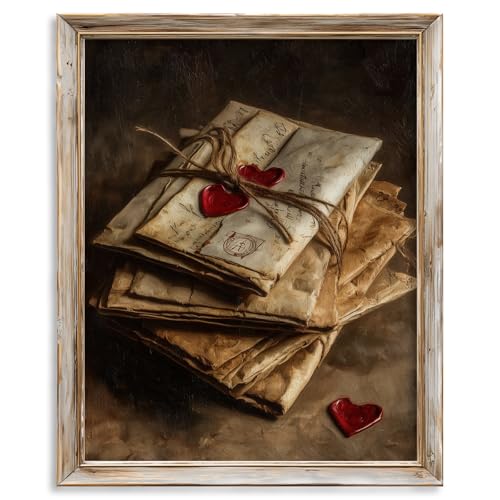
Vintage Love Letters Wall Art Print, Romantic Oil Painting Style Print with Red Wax Seal Hearts, Rustic Valentine’s Day Decor, Antique Love Letter Art, Romantic Gift for Couples (8X10inch-Unframed)
Romantic Vintage Artwork – This print features a stack of antique love letters tied with twine, adorned with…
As an affiliate, we earn on qualifying purchases.
As an affiliate, we earn on qualifying purchases.
Conclusion
As you explore these artistic portrayals of St. Valentine, you see a tapestry woven through centuries, each thread reflecting love’s evolving face. From solemn medieval paintings to vibrant modern art, these images serve as bridges across time, connecting hearts and cultures. Like a timeless melody, his story continues to inspire and evoke emotion, reminding you that love, in its many forms, remains an enduring masterpiece—forever etched into the canvas of human experience.

Framed Sacred Heart of Jesus Picture Wall Art Divine Mercy Picture Canvas Wall Decor Christ Jesus Portrait Poster Prints Christian Religious Artwork for Living Room Bedroom(12x16inch)
Sacred Heart of Jesus Wall Art: Size is 12x16in (30x40cm)Framed. The picture frame has hooks installed and is…
As an affiliate, we earn on qualifying purchases.
As an affiliate, we earn on qualifying purchases.

Framed 3 Pcs Love Heart 3d Wall Art Metal Sculpture Romantic Couple Abstract Art Prints Posters Decor Grey Black and White Canvas Printsfor Bedroom Living Room Bathroom Hotel Valentine'S Day ready to
perfect 3d wall decor gray metal couple art wall prints posters are all in different design, each printed…
As an affiliate, we earn on qualifying purchases.
As an affiliate, we earn on qualifying purchases.